

You are a couple of miles into your run along the lakefront when it shows up: a nagging ache around the front of your knee, or a sharp twinge on the outside that makes you slow to a walk. Knee pain is one of the most common reasons runners come to see us, and if it has you worried that running is off the table, take a breath. Most running-related knee pain can be sorted out, and many people keep running in some form while they recover. This guide explains why your knee hurts when you run, how to tell the common causes apart, what actually helps, and when it is time to get it checked. Our goal is to help you understand your knee and get you back to the miles you love, without drugs or surgery.
Why running knee pain happens
Here is the key idea that changes how people think about knee pain: in most runners, the knee is not broken. It is overloaded. Running sends force through the knee thousands of times per mile, and pain usually shows up when that repeated load outpaces what the joint and surrounding muscles are currently prepared to handle. That is good news, because load and strength are things we can change.
A few specific patterns account for most of what we see.
Runner’s knee (patellofemoral pain). This is pain around or behind the kneecap, and it is the single most common running knee complaint. It often flares going down stairs, after sitting for a while, or as your run goes on. As the AAOS OrthoInfo guide to patellofemoral pain syndrome explains, it is frequently linked to how the kneecap tracks and to overuse from training, and it usually responds to conservative care rather than surgery.
IT band syndrome. This is pain on the outside of the knee, where a thick band of tissue running down the outside of the thigh meets the knee. It is classic when mileage ramps up too quickly.
Training load errors. Doing too much too soon is the most common trigger of all. A sudden jump in mileage, pace, or hills, or returning to a heavy schedule after time off, loads the knee faster than it can adapt.
Strength and movement patterns. Weak or slow-to-activate hip and core muscles let the knee collapse inward with each stride, which concentrates stress at the kneecap. This is why the fix so often lives above the knee.
Runner's knee or IT band? A quick way to tell
Patients often ask how to tell these apart. As a rough guide, front-of-the-knee or behind-the-kneecap pain that worsens on stairs and after long sitting points toward runner’s knee, while sharp pain on the outside of the knee that appears at a predictable point in your run points toward the IT band. This is not a diagnosis, and the two can overlap, but it helps you describe what you are feeling. The orthopedic specialists at the Hospital for Special Surgery describe runner’s knee as an overuse problem rather than a traumatic injury, which is exactly why the path back usually runs through smarter loading and strength, not rest alone.
Pain is where you feel it, not always where it starts
One of the most useful things we tell runners is that the knee is often the victim, not the culprit. When the hip muscles that control your thigh are weak or fatigued, the thigh rotates inward and the kneecap is dragged off its ideal path. You feel it at the knee, but the driver is at the hip. That is why a good running assessment looks at your hips, core, and even your foot strike, not just the sore joint. Fix the pattern upstream, and the knee often settles.
The Chicago runner's reality
Training in Chicago comes with its own stresses on the knee. Marathon season funnels thousands of runners into big mileage jumps through late summer and fall, which is prime time for overuse injuries. Winter pushes many runners onto the treadmill or indoor track, changing stride and surface in ways the knee has to adapt to. Hard, cambered sidewalks and lakefront path repetition add up mile after mile. None of this means you should stop running. It means load needs to be managed thoughtfully, especially when your schedule or the season changes.
What actually helps
Manage the load, do not just rest. Complete rest often calms the pain, but it returns the moment you run again if the cause is unaddressed. Usually we can adjust volume, pace, and terrain so you keep moving while the knee recovers.
Strengthen the hips and core. This is the piece most runners are missing. Building the muscles that control the thigh takes stress off the kneecap and is one of the most reliable ways to keep running pain from coming back.
Look at how you run. Small changes in cadence and form can meaningfully reduce load at the knee for some runners.
Four training habits that bring on knee pain
Most running knee pain traces back to a handful of avoidable habits. Watching for these is one of the simplest ways to stay ahead of it.
Jumping mileage too fast. Large, sudden increases in weekly distance are the classic trigger. Building up gradually gives the knee time to adapt to the load.
Skipping strength work. Running alone does not build the hip and core strength that protects the knee. Two short strength sessions a week are often what separates runners who stay healthy from those who keep flaring.
Ignoring the early niggle. A mild ache that you run through for weeks often becomes the injury that sidelines you. Early, small adjustments beat late, big ones.
Only ever running. Repeating the exact same route, pace, and surface loads the knee the same way every time. Some variety, and some cross-training, spreads the stress.
Jumping mileage too fast. Large, sudden increases in weekly distance are the classic trigger. Building up gradually gives the knee time to adapt to the load.
Skipping strength work. Running alone does not build the hip and core strength that protects the knee. Two short strength sessions a week are often what separates runners who stay healthy from those who keep flaring.
Ignoring the early niggle. A mild ache that you run through for weeks often becomes the injury that sidelines you. Early, small adjustments beat late, big ones.
Only ever running. Repeating the exact same route, pace, and surface loads the knee the same way every time. Some variety, and some cross-training, spreads the stress.
None of these require fancy equipment or a coach. They are habits, which means they are within your control.
How physical therapy helps at Muscle & Joint
At Muscle & Joint Physical Therapy, we look at the whole picture, from your hips and core to your foot strike and your training history, then build a plan to calm the pain and rebuild on a stronger foundation. As an independent, employee-owned clinic that treats many of Chicago’s runners, we care about getting you back to the activity, not just quieting the symptom.
Depending on what we find, your care may include hands-on manual therapy, targeted strengthening for the hips and legs, and a smart return-to-run plan that rebuilds mileage without re-triggering the pain. For runners, our video running gait analysis lets us see exactly what your knee is doing at speed, so coaching is specific rather than guesswork. If you are training for a race, our sports rehabilitation team can help you keep training safely where possible. You can also learn more about how we work with runners on our physical therapy for runners in Chicagopage.
We cannot promise a specific outcome, since every runner is different. What we can offer is skilled hands, real recovery, and a clear path back to the road.
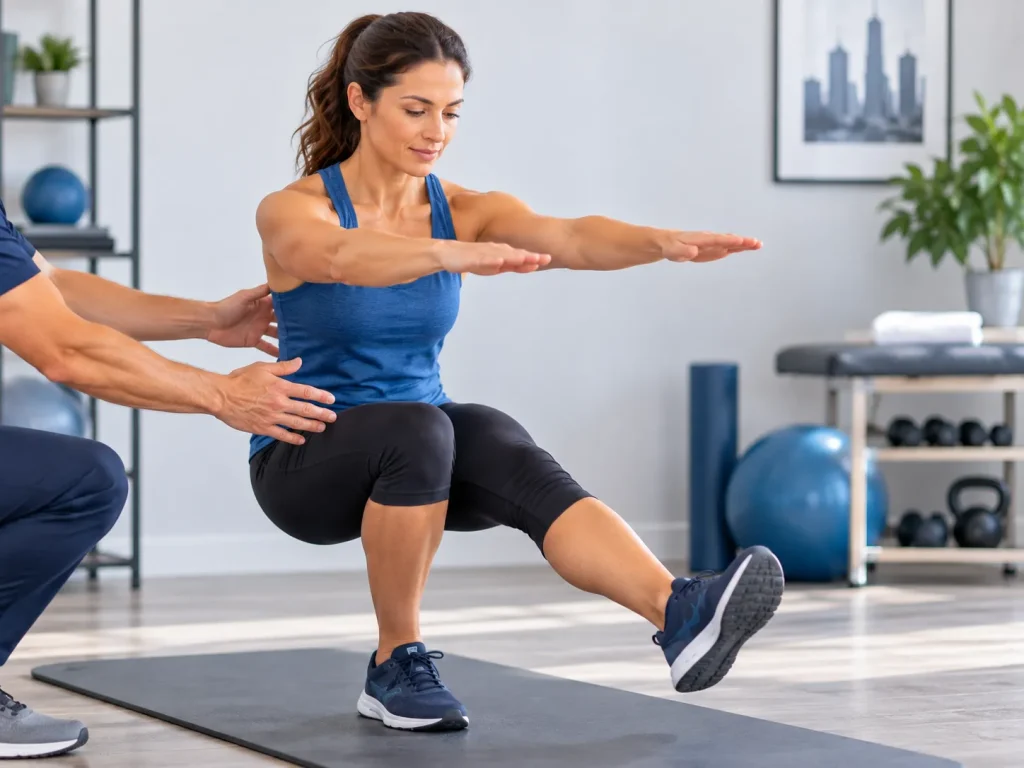
A simple self-check: keep running, adjust, or get it looked at
Probably fine to keep running, with adjustments if the pain is mild, stays around a 1 to 3 out of 10, does not get worse as you run, and settles quickly afterward. Ease back on volume and hills and see how it responds.
Time to adjust and address it if the pain climbs during your run, lingers for hours or days afterward, or changes how you move. This is the point to add strength work and, often, to get guidance.
Get it checked promptly if your knee swells quickly, gives way or locks, or the pain follows a clear injury or twist. Those signs can point to something beyond overuse and are worth a professional look.
How long until you can run pain-free?
We avoid firm promises, since every runner is different, but here is what is typical. Many runners with overuse knee pain feel meaningful improvement within a few weeks once they combine load management with the right strength work. The strengthening piece is what makes it last, so the runners who do best are usually the ones who keep up the hip and core work even after the pain fades. After your first visit, we will give you an honest, individualized sense of your timeline.
A smarter warm-up protects your knees
Many runners skip the warm-up or treat it as a quick formality, but a few focused minutes can meaningfully reduce knee load on the run that follows. The goal is to wake up the muscles that control the knee and gradually raise the tissue’s readiness, not to stretch cold and static.
Start with a brisk walk or easy jog for three to five minutes to get blood flowing before you pick up the pace.
Add a few dynamic movements such as leg swings, gentle lunges, and easy squats to switch on the hips and thighs.
Ease into pace and hills. Let the first mile be a true warm-up rather than your fastest, especially in cold Chicago weather when tissues take longer to loosen.
Cool down and check in. A short, easy finish and a quick note of how the knee felt helps you catch a problem while it is still small.
Start with a brisk walk or easy jog for three to five minutes to get blood flowing before you pick up the pace.
Add a few dynamic movements such as leg swings, gentle lunges, and easy squats to switch on the hips and thighs.
Ease into pace and hills. Let the first mile be a true warm-up rather than your fastest, especially in cold Chicago weather when tissues take longer to loosen.
Cool down and check in. A short, easy finish and a quick note of how the knee felt helps you catch a problem while it is still small.
None of this takes special equipment, and it is one of the simplest ways to keep a minor niggle from becoming a lost month of training.
Frequently asked questions
Do I have to stop running completely? Usually not. In many cases we can adjust your volume, pace, and terrain so you keep moving while we address the cause. Complete rest is sometimes needed for a short window, but it is rarely the whole answer, since the pain tends to return if the underlying pattern is unchanged.
Is knee pain always a knee problem? No. Very often the real drivers are weak or fatigued hip and core muscles that let the knee collapse inward. That is why we assess above and below the knee, not just the joint itself.
Should I foam roll my IT band? Foam rolling can feel good and may offer short-term relief, but it does not fix the underlying load and strength issues. Think of it as a warm-up or recovery tool alongside the real work, not a substitute for it.
What is a running gait analysis, and do I need one? It is a video look at how you actually run, so we can spot the movement patterns loading your knee and coach specific changes. It is especially useful for recurring or stubborn running pain.
Can I run a marathon after knee pain? Many runners do. With a smart return-to-run plan and consistent strength work, plenty of people get back to long-distance training. The key is rebuilding load gradually rather than jumping straight back to peak mileage.
Get back to the run you love
Knee pain does not have to be the end of your running. With the right plan, most runners get back to the road, often stronger than before. Muscle & Joint Physical Therapy has two Chicago locations, Lakeview and Ravenswood, and a team that knows the local running scene.
Ready to start? Request an appointment online, or give us a call:
Lakeview: 773-857-0689
Ravenswood: 773-337-7747
Where Comebacks Happen.®
This article is general health information, not medical advice, and reading it does not create a provider-patient relationship. Every person is different. Please talk with a licensed physical therapist or physician about your specific situation. If your symptoms are severe or worsening, please see a provider promptly.